Leadership in Transition: What Theater Rehearsals Reveal About Team Dynamics
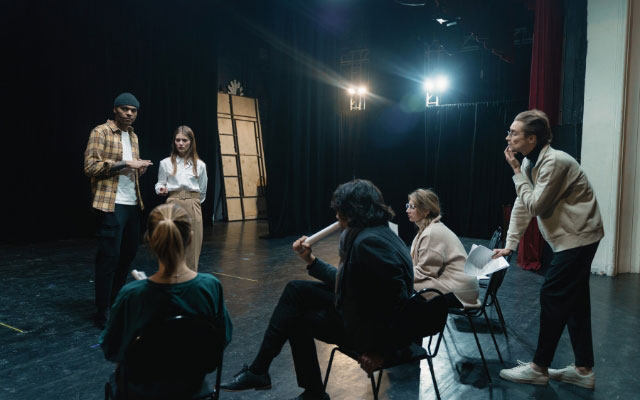
Leadership in transition often shows itself where we least expect it – for example, in a community theater project. I stand on a rehearsal stage with eleven women. Each of us brings something along: a role, a script, our own expectations. But as soon as the first scene begins, it becomes clear: the path from imagination to reality is full of friction. And in that friction lies potential.
What plays out on stage is more than theater – it is a mirror of group dynamics: misunderstandings, withdrawal, defiance, unexpected twists. All of it echoes phases that teams, projects, and change processes go through. It is the storming phase – not a failure, but a sign of aliveness. Those who stay mindful can discover and shape real connection here.
In this article, I share how rehearsal time inspired me to rethink leadership – not as an instrument of power, but as the practice of holding space for transformation. And I show why formats such as the Entrepreneur Council consciously create just such experiential spaces – beyond control, toward collective possibility.
Leadership in Transition – The Rehearsal Space as a Space of Experience
An empty room. A few chairs. A script in hand. What starts simple quickly becomes complex: each person enters with inner images – of their role, the ensemble, the ideal flow. But what unfolds is less controllable than expected. Suddenly tension arises. A gesture irritates, a comment triggers. Rehearsal becomes a mirror of what lives inside.
In such moments, the rehearsal room becomes a real learning space. Here we meet not just the play, but our own mindfulness. How present am I? Do I truly listen, or just wait for my cue? Do I leave space for others – or unconsciously defend my idea of “how it should go”?
These dynamics resemble team processes: ideals meet reality. And as in theater, it becomes clear that transitions are never smooth. Leadership in transition reveals itself in these threshold moments – when expectations are disappointed, roles feel uncertain, and structures turn porous.
What is needed then is not quick fixes, but a conscious stance. One that recognizes: everyone brings not just a script, but a story. Sometimes, listening must come first before the next step can emerge together.
The Storming Phase – Not Weakness, but a Sign of Vitality
As soon as people begin to interact, differences in perception appear. Small misunderstandings suddenly loom large. Someone withdraws, another becomes loud. The so-called storming phase begins – the moment when groups rub against each other, orient themselves, and sometimes collide.
What looks like chaos is actually a natural part of every collective process – and more than that: it is a sign that life is pulsing in the group. Attempts to avoid or “smooth over” this phase prevent growth. Because it is precisely here that needs, blind spots, and potential come to the surface.
In theater as in teams, more pressure doesn’t help – connection does. Holding contact, asking questions, showing up instead of closing down. Humor can work wonders: a smile that eases tension, a sentence that widens perspective.
The drama triangle is visible here too: victim, persecutor, rescuer – roles we unconsciously adopt. But those who pause can see the play – and step out of it. Thus the storming phase becomes not a problem, but a portal: toward trust, clarity, and shared creation.
Leadership in Transition – From Solo Players to Ensemble
Leadership in transition shows itself where the goal is not yet clear, and the path emerges together. In such phases, less control is needed – and more contact. A fine sensing of dynamics, and the courage to step right into the middle of them. Theater rehearsals are a surprisingly precise mirror: focus only on your own lines, and you miss the sound of the whole.
What happens on stage is not side business, but a learning ground for collective action. Every voice matters, every reaction shifts the picture. Leadership becomes the art of holding space – for difference, for searching, for shared development.
Three stances support this process:
- Enabling co-creation: Good leadership invites others in. It moderates, rather than dictates. In transitions, this builds trust and sparks new perspectives.
- Acknowledging diversity: Different impulses and expressions make teams alive. An ensemble thrives on difference. Leadership means navigating tension, creating space without prematurely resolving it. Here, mindful connection unfolds.
- Clarity without rigid answers: In shaky structures, orientation is needed. But orientation doesn’t mean having all the answers – it means staying present, keeping questions open, accompanying processes attentively.
Self-worth plays a quiet, stabilizing role here. Those grounded in themselves need neither to mask nor to control. That stance makes leadership in transition sustainable – because it doesn’t insist on a script but opens a play space.
Council as a Stage for New Narratives
Sometimes new conversations need new spaces. Spaces where efficiency gives way to authenticity. Where questions matter more than answers. Where the stories behind positions become audible. The Council is such a space.
For many leaders, it is like a second stage – one not for performance, but for truth. In Council, people sit in a circle. No agenda, no judgment, no pressure to achieve. Speaking arises in the moment. Listening happens with the heart. As simple as it sounds, this practice profoundly shifts the quality of encounter.
Especially in leadership transitions, such spaces are vital. Because transitions cannot be managed like project plans. They require relationship, resonance, courage for uncertainty. Council creates that container – like an ensemble meeting offstage to sense what really matters.
The Entrepreneur Council
In the Entrepreneur Council, leaders experience precisely this: honest connection without masks. Everyday roles – decision-maker, visionary, troubleshooter – step back. Instead, people meet who carry responsibility and still ask: How do I really feel about this? What overwhelms me? What inspires me?
Here, new narratives arise. Not as strategies, but as resonance. Listening changes us. Speaking reorders us inside. Out of single voices emerges a shared sound – and often, a new view of one’s leadership role.
This form of dialogue is not a method in the usual sense, but a stance. It shows that leadership is not always about speaking – but often about listening. About leaving space for what wants to emerge. About allowing connection – even where there was separation.
In a time when many teams are under pressure and organizations must reinvent themselves, Council is a precious space of possibility. A stage without spotlights, but with depth. A place where futures can grow – from genuine encounter.
Conclusion: Leadership in Transition Begins in the In-Between
Leadership in transition does not show itself on the big stage, but in the subtle space in-between – between expectation and reality, between role and encounter. Rehearsals make tangible how close leadership is to our humanity: those who show up where nothing is yet clear create connection. Those who listen where others get lost provide orientation.
In ensemble processes and in Council alike, a valuable learning space emerges: not for finished answers, but for true team-writing – a shared story composed of many voices. Here, leadership can unfold anew: not as the authority who must know everything, but as the one who holds space. For change. For difference. For resonance.
Perhaps this is the true art of leadership: not to control the stage, but to shape the space where others can flourish.